When do salmon run in Bowmanville Creek?
Chinook stage off Port Darlington from early July and push into the creek from mid-to-late August, peaking mid-September through mid-October. It's a small creek with a big run. The fish only get upstream because a few hundred volunteers once carried them over a dam by hand.
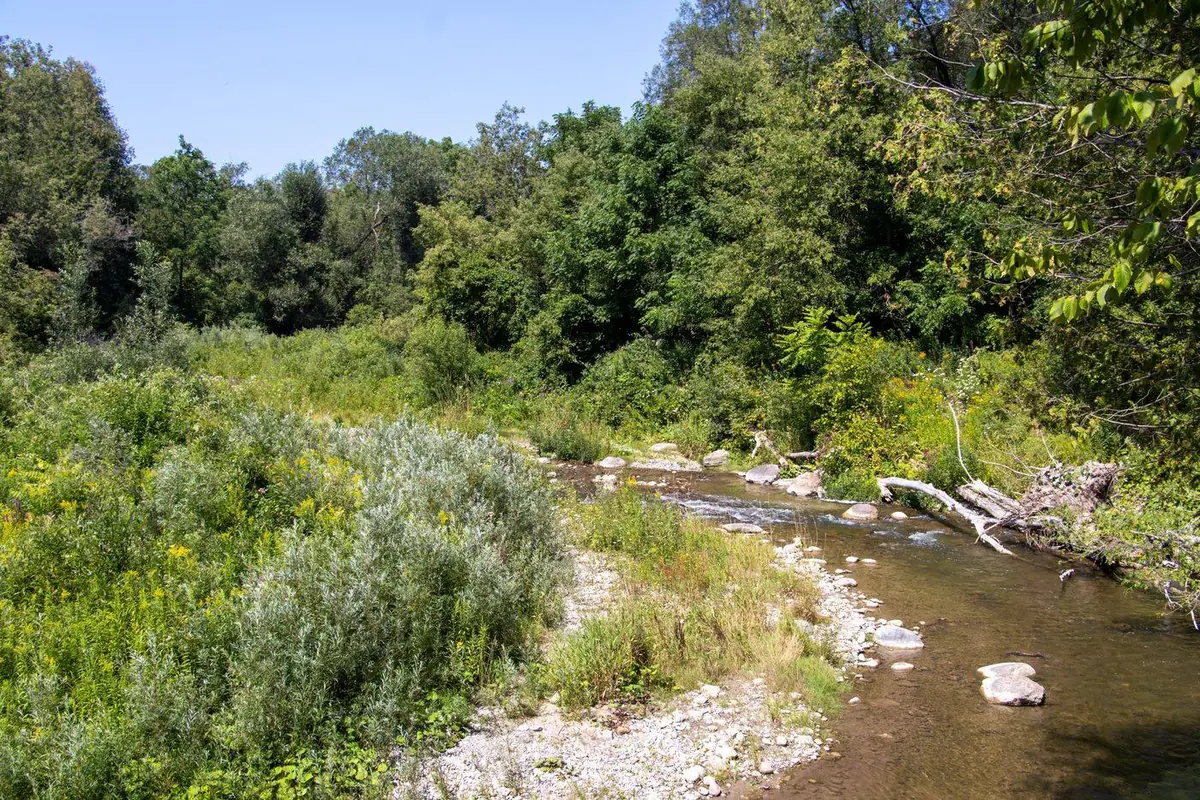
Bowmanville is a creek, and that shapes almost everything about fishing it. It rises and drops fast, and holds a lot of fish in not much water. I check the gauge the day after rain here. Wait three days and you've missed it, and you're back to low and clear.
Bowmanville fishes best between 1 and 8 m³/s. Below that the fish stack in the deeper pools and get very spooky. Above it, fish the slower inside edges instead of the main push.
After solid rain it takes one to two days to drop. The Ganaraska needs several. Aim for the back half of that window, when levels are falling but the water still carries colour.
See today's flow, water temperature and staging →I fished it last weekend and there were very few fish, far fewer than I'd normally expect in early September. That's odd, because we'd had good rain beforehand, and that usually brings them in.
My guess is that a body of fish ran on that water and kept going, and by the time the creek dropped clear enough to fish they were already well upstream. On a creek this size you can go from too high to already moved through in a single day. That's the trade-off for water that clears in one to two days instead of several.
I still got into one, so they were not all gone. But if you fished it early this month and wondered where everything was, that is my read.
The run, week by week
| Window | What's happening | Where to fish |
|---|---|---|
| Early July | Chinook stage off Port Darlington | Harbour and pier |
| Mid–late August | First fish enter the creek | Lower creek, below the dam |
| Sept – Sept 30 | Peak run, whole creek open | Lower creek and the valley reaches |
| Oct 1 – Dec 31 | Run continues; above Hwy 2 now closed | Below Hwy 2 only |
| Jan – Apr | Steelhead | Below the CNR only (the year-round reach) |
Bowmanville sits in the eastern group, so it runs early, alongside the Ganaraska and Wilmot and two to three weeks ahead of the Credit or Bronte. If you fish the Toronto rivers and come out here on your usual schedule, you will be late.
Bowmanville sits in the Regional Municipality of Durham, and Zone 17 splits the creek into three bands. How late in the year you can fish depends on where you stand.
Below the CNR right-of-way, down to Lake Ontario: open all year. This is the only part of the creek with no closing date.
Between Highway 2 and the CNR right-of-way: extended fall season, fourth Saturday in April to December 31.
Above Highway 2: the zone-wide season applies, fourth Saturday in April to September 30. Trout and salmon fishing is closed here from October 1.
The peak weeks are fishable, but more and more only on the lower creek. If you are used to walking upstream in October, check which side of Highway 2 you are on.
No fishing within 120 metres upstream or downstream of the fish ladder at the Goodyear Dam, at any time of year. The ladder is roughly one kilometre north of the Baseline Road parking lot. Confirm the current rules and the exact boundaries in the Ontario fishing regulations for Zone 17 before you fish.
Why there is a fish ladder at all
The Goodyear Dam is about three metres of concrete, and for years it was effectively the end of the run. An older passage had been built for trout, but when Chinook were introduced they couldn't make the jump. They piled up at the base, exhausted themselves, and died there. The estimate at the time was that only about one per cent of the big salmon made it upstream to spawn.
So people started lifting them over by hand. A local named Dave Lawson had rigged a bag-and-pulley system years earlier for trout; in 2012, with a new bypass channel behind schedule and an early run arriving, volunteers from the community group Valleys 2000 stood in the pool below the dam and moved 5,540 fish over it in nets and sacks. The following year, with construction still going, they did it again and moved more than 10,000 fish.
The bypass channel finally opened on 16 December 2013: four tiered pools, about $450,000, most of it raised locally. That's what the 120-metre no-fishing zone protects. Given what it took to get built, give it room.
What a morning here is like
It gets busy through September and October, but it's quieter and more spread out than Port Hope. You also share it with people who aren't fishing. The valley trail is paved and level, and you'll pass families, dog walkers and photographers on the way to the water.
It's also a lovely place to spend a morning. The last time I was down there a friend logged the calls of around fifteen different bird species in two hours, without trying especially hard. You don't often get that on a salmon river twenty minutes from the 401.
You can stand at the ladder and watch fish work their way up it. Plenty of people come down just for that, and never make a cast.
Where to fish it
Port Darlington and the harbour hold staging fish from July, before they commit to the creek. Spoons and spinners at dawn and dusk.
The lower creek, below the dam, is the main event through September and October. Float-fished roe or beads through the deeper pools. Mind the 120-metre boundary around the ladder.
Above the bypass, fish that have made it up are more spread out and the water is quieter. The walk pays off.
There is also a wheelchair-accessible fishing spot on the trail south of the Goodyear Dam and north of Spry Avenue, put in where studies showed fish congregate. That's more thought than most rivers get.
Barber's Creek
It wasn't always called Bowmanville. The creek was originally Barber's Creek, after the early settler Augustus Barber. Around 1820 the Burk family (one of three Loyalist families who arrived in the 1790s) built a saw and grist mill on its banks, and the village that grew around it was called Darlington Mills. By 1830 the village had been renamed Bowmanville, and the creek followed.
Through the nineteenth century that water powered a remarkable amount of industry for a creek this size: potteries, a distillery, a soap works, an oatmeal mill, a foundry, a tannery, woodworking and machine shops. The Vanstone Mill still stands at the western approach to downtown, and by the 1880s it was turning out 150 barrels of flour a day.
The creek itself starts on the Oak Ridges Moraine, and that matters for anglers. The groundwater recharge keeps a creek this small cold enough to hold salmon and trout.
Common questions
When do salmon run in Bowmanville Creek?
Chinook stage off Port Darlington from early July and enter Bowmanville Creek from mid-to-late August, peaking mid-September to mid-October. Seasons differ by reach: below the CNR right-of-way is open all year, between Highway 2 and the CNR the season runs to December 31, and above Highway 2 trout and salmon fishing closes on September 30.
Can you fish at the Bowmanville fish ladder?
No. Fishing is prohibited within 120 metres upstream and downstream of it. You can watch (and you should), but you can't fish that stretch.
How long does Bowmanville Creek take to clear after rain?
One to two days, much faster than the Ganaraska. Time your trip for the falling half of that window.
Is Bowmanville Creek crowded during the salmon run?
Busy through September and October on the open water, but noticeably quieter than Port Hope, and the valley draws plenty of people who are there for the walk rather than the fish.
Read next
If you miss the window here, Bronte Creek at the western end of the lake runs weeks later and holds fish into November.
Timing for every Ontario river is in the river-by-river salmon run guide. The Ganaraska at Port Hope runs on a similar schedule but fishes completely differently. It's bigger water with bigger crowds, and it has a six-week closure in the middle of the run. For the drift itself, see the three float fishing tips that matter most in tight water.